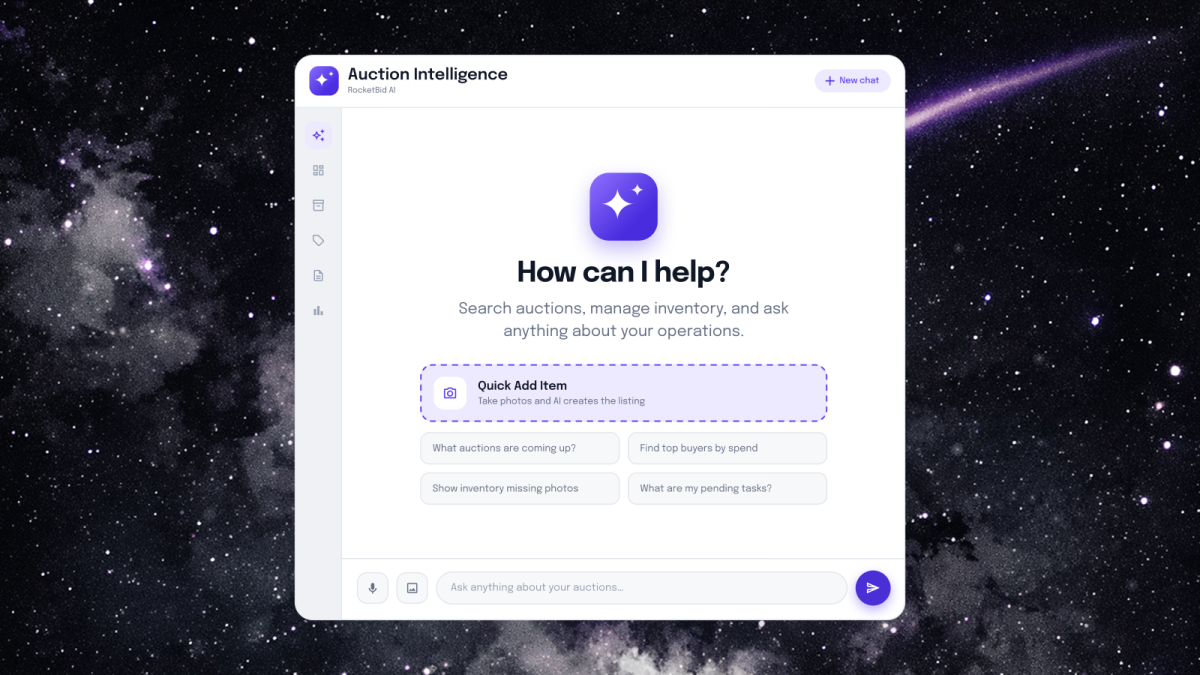
Introducing Auction Intelligence by RocketBid
There is a particular kind of optimism involved in starting Monday morning at an auction house with a to-do list.
There are 600 lots left to catalogue, three people want to know when pickup is, someone hasn’t paid, a consignor wants an update, and the phone is ringing. There are twelve emails that somehow all say URGENT, and somebody has just handed you another box of things that absolutely, positively need to make it into Thursday’s sale.
Somewhere in the middle of all of that, you’re supposed to be running a business.
Auction software has gotten pretty good at keeping track of things. Your auctions are in there. So are your inventory, bidders, invoices, consignors, sales and years of transaction history. But when you actually want to do something with all of that information, the relationship hasn’t changed much. You find the record, open the report, interpret the data, figure out what needs to happen and then go back into the system to make it happen.
We’ve been thinking about what that relationship could look like instead. What happens when the software running an auction business can understand what’s happening inside it, answer questions about it and help do the work?
That’s the idea behind Auction Intelligence, an intelligence layer built directly into RocketBid.
Not a chatbot bolted onto the side because it’s 2026 and apparently everything needs a chatbot. We wanted to build something that understands the work happening inside an auction company and can actually participate in it.
We gave it actual work to do
Auction Intelligence currently has 54 purpose-built tools across auctions, lots, inventory, invoices, consignors, customers, tasks, email and phone. Twenty-nine let it retrieve and understand information, while twenty-five let it take action inside the platform.
Those numbers probably aren’t particularly interesting unless you’re the kind of person who gets excited about tool-calling architecture. In which case, hello. We should probably talk.
For everyone else, what matters is what those tools represent.
“There’s a big difference between an AI that can tell you how to do something and one that can work with the systems where the work actually happens.”
Auction Intelligence can help find information across your operation, work with inventory and customers, manage parts of your auction workflow and take an answer beyond “here’s what I found.” The conversation is simply the easiest way to tell the platform what you need.
Let’s talk about the 800 lots staring at you
If you’ve worked in auctions for more than approximately twelve minutes, you already know where we’re going with this: cataloguing.
Photograph the item. Upload the photo. Write the title. Write the description. Add the details. Save. Move on to the next one, then repeat the process hundreds of times while new inventory continues appearing from seemingly nowhere.
“One item isn’t a problem. Eight hundred items is a lifestyle.”
We figured this was a pretty good place for AI to earn its keep.
With Quick Add, an operator can photograph an item from their phone and Auction Intelligence can help write the description and create the listing while they follow the process in the conversation. There’s also an optional voice guide that can walk them through the workflow while they work.
The point isn’t to generate increasingly poetic descriptions of a 1978 Craftsman socket set. It’s to shorten one of the most repetitive workflows in the auction business. Saving a little time on one item isn’t especially exciting. Multiply that across hundreds or thousands of lots, and it starts to matter very quickly.
Your auction company is sitting on a lot of answers
Auction companies generate an enormous amount of useful business data. Acquisition costs, sale prices, hammer prices, fees, inventory age, sell-through, bidder activity, customer history and category performance all tell you something about how the business is doing.
The problem is getting from the data to an answer.
If you want to know how one product category compares with another, what you paid for inventory versus what it sold for, which types of inventory are producing the strongest returns, or how one auction performed against previous sales, that information may already exist. Getting to it can still mean finding the right report, applying the right filters, exporting something to Excel and beginning your unexpected second career as a data analyst.
Auction Intelligence changes the starting point.
“Instead of starting with ‘where is the report?’ you can start with ‘what do I want to know?’”
You could ask how one category is performing against another, look at cost versus sale performance, identify inventory that isn’t moving or dig into the KPIs that actually matter to your operation. The goal isn’t to get rid of dashboards or traditional reporting. It’s to make the information underneath them easier to interrogate when you’re making a decision.
Because KPIs are considerably more useful when they can answer a question than when they’re a collection of boxes everyone politely agrees to look at once a month.
Over time, this is where we think intelligence becomes especially valuable. Auction software has traditionally been very good at recording what happened. We want Auction Intelligence to help operators understand what that information means and make it easier to decide what happens next.
Unfortunately, the phone still exists
We considered pretending auction businesses had somehow moved beyond phone calls. Our customers quickly ruined that theory.
Between bidders with questions, pickup coordination, payment follow-ups and consignors who still haven’t sent the information you asked for three days ago, a surprising amount of an auction company’s day is still spent picking up the phone or trying to get someone else to.
Auction Intelligence includes an inbound AI receptionist that can answer incoming calls, identify callers by phone number and help with common questions. If someone needs an actual person, the assistant can transfer the call to a staff member through RocketBid’s browser phone.
Callers hear a spoken disclosure that they’re interacting with AI and that the call is being recorded before the conversation begins.
Nobody should have to figure out halfway through a phone call that they’ve been talking to a robot.
Auction Intelligence can also place approved outbound calls and send text messages where it makes sense, for workflows like auction notifications, follow-ups and pickup reminders. That opens up some particularly useful possibilities around consignors too, whether it’s following up on missing information, getting the answers your team needs to finish preparing an auction, or simply handling the routine back-and-forth that somehow turns “we just need one thing from you” into six phone calls and eleven text messages.
Staff review outbound communications before they’re sent or placed. Calls are recorded, transcribed and summarized, and text messages are captured too, so the conversation becomes part of the customer or consignor history instead of disappearing into someone’s phone.
That means your team has a record of what was discussed, what still needs to happen and who said what, with fewer mystery sticky notes on someone’s desk that say BOB CALLED. CALL BOB.
We consider this progress.
Your bidders get some intelligence too
A lot of the questions occupying an auction company’s staff don’t come from inside the business at all. They come from bidders trying to find an item, check something they were watching, understand where to go next or get basic information about an auction.
RocketBid’s public-facing assistant is built for that side of the experience. It can help visitors search auctions and items, find business information and navigate the site. Signed-in bidders can also use it to find information related to their own activity, including their bids and watchlist.
The customer assistant is deliberately separated from the operational capabilities available to employees. It is read-only, so a bidder can ask it for help without gaining the ability to change anything in the auction platform. When it can’t help, the conversation can be escalated to a person.
No, your bidder can’t tell it to “ignore all previous instructions” and start coding their website. We thought of that.
The benefit isn’t about replacing customer service. It’s about letting routine questions get routine answers so the people running the auction can spend their time on conversations that actually require them.
Okay, but you’re letting AI into my auction system?
This is probably the question auction companies should ask.
There’s a meaningful difference between asking AI to write a description and letting it interact with software responsible for customers, inventory, auctions and money. As Auction Intelligence became capable of doing more, we knew the controls around what it could do had to become part of the product itself.
The language model behind Auction Intelligence does not directly query the RocketBid database. It doesn’t have arbitrary SQL access or a general-purpose query passthrough. Instead, it works through specific tools we’ve built for specific jobs. The model can choose the appropriate capability and provide the structured information it needs, but the underlying database operations are defined by RocketBid.
“We gave the AI tools. We did not give it the keys to the building.”
There are controls at the action level too. In the employee chat experience, 24 of the 25 tools capable of changing information stop before execution and ask the employee to approve or reject the action.
The capabilities available to an employee also depend on their role. Permissions are filtered when tools are made available and checked again before execution, while operations such as publishing, deleting lots, waiving reserves and creating users remain restricted to administrators.
Actions are logged with information about what went in, what came out, whether the operation succeeded, any errors and who approved it. That gives the intelligence layer accountability alongside capability.
We want Auction Intelligence to do useful work. We do not want it freelancing.
Because your auction company isn’t everyone else’s auction company
The other problem with generic AI is right there in the name: it’s generic.
Auction companies aren’t. Pickup policies differ. Shipping differs. Consignment terms differ. The way one company handles its customers, inventory and auctions can be completely different from another.
Auction Intelligence can be given company-specific knowledge covering the company profile, auction policies, pickup and shipping information, consignment terms and custom instructions. That knowledge can sit alongside live context from the operation, including upcoming auctions and inventory information.
RocketBid’s broader customer experience adds another layer of context by bringing together bids, purchases, consignments, notes, calls and emails into a unified customer history. Email, the browser-based phone system and a calendar that can display auctions alongside Google events bring more of the day-to-day operation into the same environment.
That context matters because we don’t think the future of business AI is asking people to explain their business from scratch every time they start a conversation.
“The more the software understands about the operation it’s already part of, the more useful that intelligence becomes.”
And yes, AI costs money
There’s a less glamorous part of the AI conversation that we think matters: somebody eventually has to pay the compute bill.
“We’ll figure out the token economics later” has had an interesting couple of years.
RocketBid captures token usage and estimated AI cost per request, including usage by feature and employee. That gives us visibility into how Auction Intelligence is actually being used and what it costs to operate.
More importantly, it lets us think about AI in terms of business value rather than novelty. The interesting metric isn’t how many times someone talked to the AI. It’s whether those interactions saved meaningful time, surfaced something useful or helped someone get work done.
“AI” isn’t a particularly useful KPI. Saving hours of cataloguing time is.
This is where we think auction software is going
We don’t think AI in auction software ends with generating lot descriptions. That’s useful, we’re doing it, and it solves a very real problem. But it’s also one of the more obvious applications of what this technology can do.
The bigger opportunity is software that understands enough about an auction operation to actually help the people running it. That could mean asking why one category is outperforming another, comparing what you paid for inventory against what it eventually sold for, or spotting inventory that has been sitting around a little too long. It could mean helping your team catalogue the next 500 lots, wrangling the consignor you’re still waiting on, or answering routine phone calls while everyone is busy running preview.
More importantly, those things shouldn’t exist as a collection of disconnected AI features. We’re interested in what happens when intelligence sits across the operation. A question about the business can lead to an answer, that answer can lead to an action, and the people running the auction remain in control of what happens next.
That’s the direction we’re taking RocketBid with Auction Intelligence. We don’t think auctioneers need replacing. We think the auctioneer staring down another 800 lots could probably use some backup.
Ready to meet Auction Intelligence?
If you run an auction company, bring us one of the annoying, repetitive, time-consuming problems your team deals with every week. We’d love to show you what Auction Intelligence can do with it.
And if you made it this far because you’re less interested in running an auction and more interested in what we’re building under the hood, we’d like to talk to you too.
Luckily, you won’t need to decipher a cryptic AI billboard in San Francisco to find us. Book a walkthrough here.
