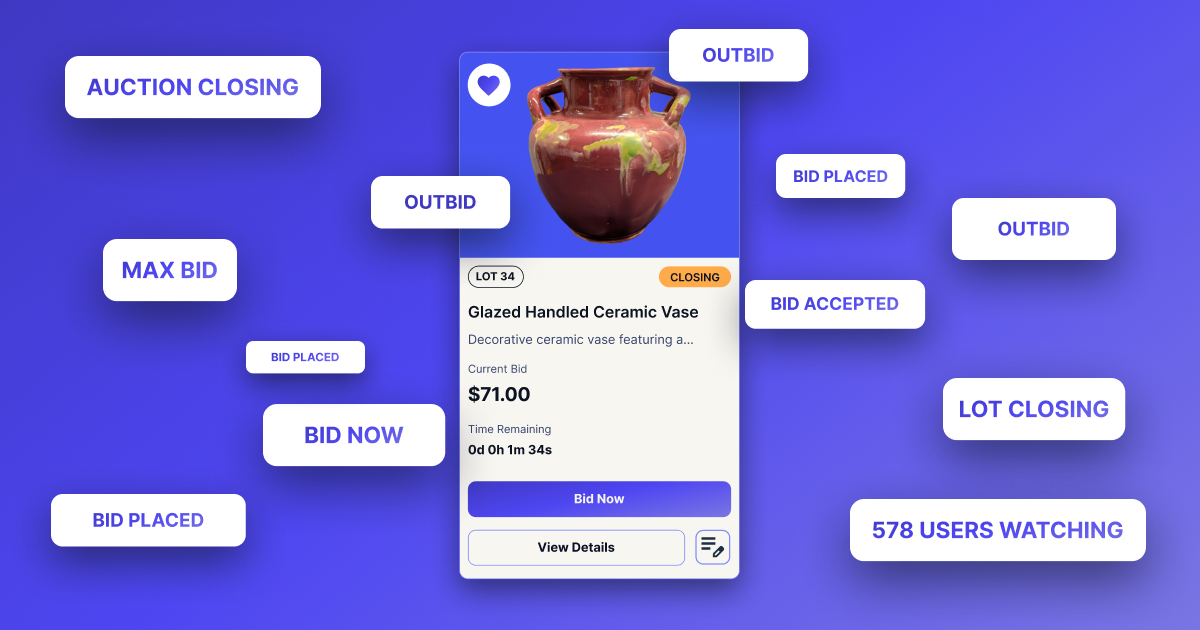
Most auction software is designed to behave in a demo. Outside of that environment, the cracks tend to show.
The moment that truly reveals an auction platform is not a walkthrough or a feature tour. It is lot close. Bids arrive in bursts, timers extend in rapid succession, and dozens of people act at once, all expecting the system to behave fairly and predictably. That is where software either holds together or begins to show its limits. This is not the moment you want to discover an edge case¹.
When an auction platform fails under pressure, the impact is not abstract. Auctioneers are left answering emails the next morning. Bidders question whether outcomes were fair. Trust erodes, and it takes far longer to rebuild than a server or a process.
At RocketBid, we design for that moment first, because it is the one that decides whether everything else matters.
Built inside real auctions
Before RocketBid was a product, it was shaped inside real auctions. We built and tested these systems under live conditions, learning where timing breaks down, where workflows slow people down, and where software adds friction instead of removing it.
You can run a comprehensive test suite², simulate traffic, and validate scenarios in isolation. But the moment of live action at lot close is the real indicator. That is when systems reveal whether they truly hold together.
Many of those lessons were learned the hard way during live auctions, with real bidders, real money, and no pause button. That experience is now baked into the platform, so auctioneers do not have to learn those lessons at their own expense.
Reliability is not a feature
Reliable auction software is not defined by feature lists. Real-time bidding and secure payments are expected. What matters is how a system behaves when contention³, timing, and pressure converge, and whether it supports auctioneers or forces them to become IT support at the worst possible moment.
That is why RocketBid is built as a single, auction-native platform, not a collection of loosely connected tools or a generic ecommerce system adapted for auctions. We focus on predictable behavior under load⁴, server-authoritative timing⁵, and infrastructure designed to absorb volatility⁶ rather than amplify it. Auctions are chaotic enough on their own.
Clarity when it counts
Performance alone, however, is not enough.
In a live auction, clarity matters just as much as speed. No one has time to hunt through menus, second-guess actions, or remember where something lives. Every unnecessary decision increases cognitive load⁷ at exactly the wrong moment, usually while a ringman is calling a bid from the back of the room.
RocketBid is designed around a natural auctioneer workflow. Less searching, more doing. The right tools surface when they are needed. The next step is clear. The software supports momentum instead of interrupting it.
Feature-heavy platforms often mistake abundance for capability. We take a different approach. RocketBid includes the tools auctioneers actually use and introduces them only when they are relevant. Fewer distractions. Fewer decisions. A system that stays focused on the work at hand, because “just in case” features have a habit of showing up exactly when you do not need them.
When pressure proves the design
When inventory, bidding, timing, payments, and reporting all operate inside the same system, pressure does not expose seams. It proves the design.
Auctioneers do not need more features. They need confidence in how the system behaves when it matters most. Consistent bidding, predictable lot close, and outcomes that do not need explaining.
Great auction software earns trust under pressure by doing the fundamentals right, every time.
Footnotes (plain English)
¹ Edge case
A rare or unexpected situation that does not show up in demos but absolutely shows up in real auctions, usually at the worst possible time.
² Test suite
A collection of automated checks used to verify parts of a system before it goes live. Useful for catching issues early, but limited in how well it can reflect real-time pressure, human behavior, and unpredictable bidding patterns.
³ Contention
When multiple bidders all try to act at the same time, especially in the final seconds, and the system must decide what happened first, fairly and consistently.
⁴ Behavior under load
How the platform performs when traffic suddenly spikes. Not “does it work when it’s quiet,” but “does it still work when everyone shows up at once.”
⁵ Server-authoritative timing
A fancy way of saying the server decides when a bid counts, not someone’s browser, Wi-Fi speed, or a slightly wrong laptop clock.
⁶ Absorbing volatility
Designing the system so sudden changes like more bidders, more bids, or more extensions do not cause strange behavior or surprise failures.
⁷ Cognitive load
The mental effort required to use the software. More menus, more choices, more guesswork means more chances for mistakes when things get busy.
