It Starts With Attention
When was the last time you consciously decided to keep scrolling?
Probably never.
Every day we make hundreds of tiny decisions about what deserves our attention. A headline on Facebook. A thumbnail on YouTube. An Instagram Reel. A Marketplace listing we definitely weren’t looking for. A video of someone pressure washing a driveway that, for reasons nobody can quite explain, suddenly becomes the most compelling thing we’ve watched all afternoon.
Most of those decisions happen before we even realize we’ve made them.
Social media platforms have become remarkably good at measuring attention. Every click, pause, swipe, and scroll tells them something about what interests us, which is why marketers have become obsessed with “the first three seconds.” Whether it’s actually three seconds or five isn’t really the point. The point is that first impressions happen incredibly fast.
It’s easy to think this is just a social media problem.
The more we’ve talked about it at RocketBid, though, the more we’ve realized that auctions work in much the same way.
Long before someone places their first bid, they’ve already decided whether your auction is worth their attention. They’ve looked at the cover image, skimmed the title, glanced at the featured lots, and made a surprisingly quick judgement.
Is this worth clicking?
Most of the time, that decision takes only a few seconds.
You’re Not Competing With Other Auctions
It’s tempting to think your biggest competition is another auction house running a sale the same weekend.
In reality, your next bidder might discover your auction while scrolling Facebook during lunch. Thirty seconds earlier they were watching a Golden Retriever enthusiastically launch itself into a lake, checking hockey scores, or reading a comment section that had absolutely no business becoming a full-blown debate.
Then your auction appears. Like every other post in that feed, it has a split second to answer a simple question: “Is this worth my attention?” Before anyone places a bid, they’ve already answered it.
Every Auction Has a Hook
Spend enough time around YouTubers and you’ll eventually hear someone talk about “the hook.” It’s the opening shot, the thumbnail, the title, or the first sentence that convinces someone to stop scrolling. Auction houses have hooks too, although they’re usually a little less dramatic than “You won’t BELIEVE what happened next…” A great featured lot, a beautifully photographed catalogue cover, or even a well-written auction title all serve the same purpose: giving someone a reason to click. Not through clickbait, but by sparking genuine curiosity.
People Don’t Bid on What They Never Notice
Imagine these two listings appearing side by side.
Vintage Wooden Chair
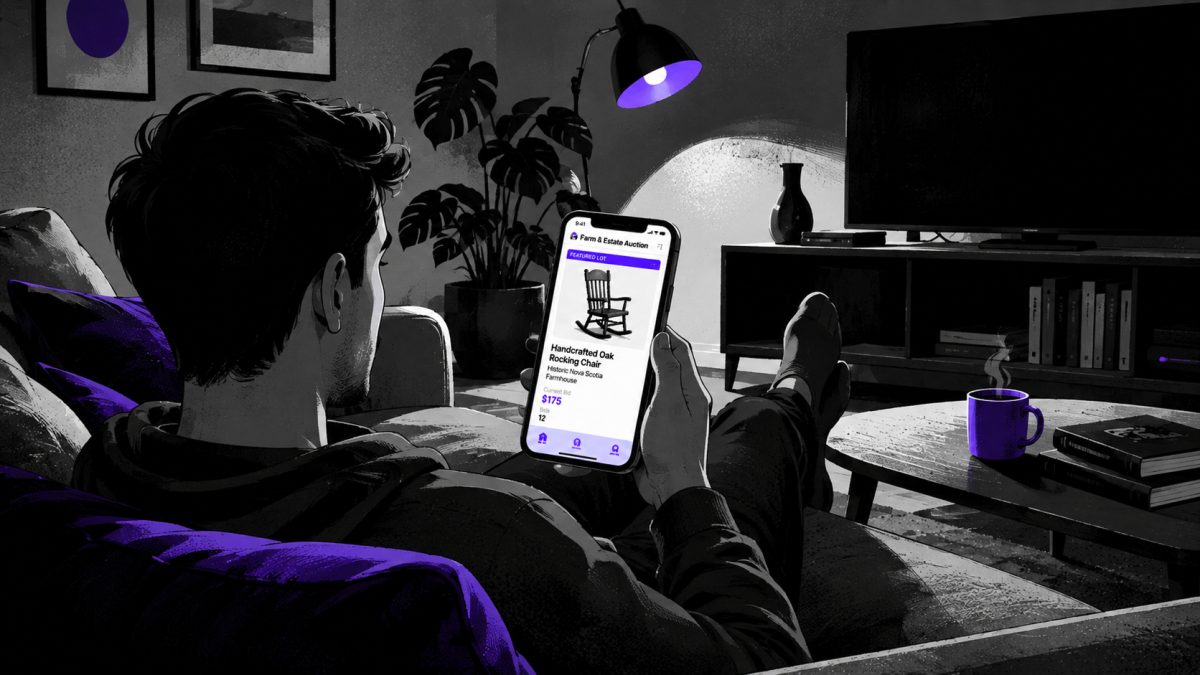
Handcrafted Oak Rocking Chair from a Historic Nova Scotia Farmhouse
It’s still the same chair. We haven’t changed the item—we’ve changed the way it’s introduced.
The second listing gives people something to picture in their minds. It hints at craftsmanship, history, and provenance, making you pause for just a moment longer. Great auction listings aren’t about writing flowery descriptions or piling on adjectives. They’re about giving someone a reason to care enough to click.
Good Design Removes Friction
As designers, we’re probably a little biased. Actually… we’re definitely biased. But presentation matters because people make decisions visually long before they start reading descriptions. A clean catalogue is easier to browse, consistent branding builds confidence, and strong photography helps bidders understand what they’re looking at without making them work for it.
And yes, photography deserves its own paragraph. If your photos look like they were taken from the passenger seat of a pickup truck while rolling through the yard at 15 km/h, it might be time for a second attempt. Great photography doesn’t change what’s being sold—it simply makes it easier for people to discover it, trust it, and keep exploring. That’s often the difference between someone scrolling past and someone sticking around.
Attention Creates Competition
Attention isn’t the finish line—it’s where every auction begins.
Every additional person who discovers an auction is another potential bidder, and every additional bidder creates the opportunity for more competition. That’s ultimately what every consignor wants, which is why we’ve come to think about marketing a little differently. It’s not something that happens before an auction; it’s simply the first chapter of the auction itself.
The first bid may not arrive until Friday night, but the auction probably started on Tuesday afternoon, somewhere between a dog video, a Facebook Marketplace listing, and someone’s vacation photos. That’s when someone paused for a moment, clicked your auction, and decided it was worth exploring.
One Last Thought
No, we’re not suggesting auctioneers start filming TikTok dance trends beside a skid steer. Although, if someone does, we’d be lying if we said we weren’t at least a little curious.
The point is much simpler than that.
Social media has taught us that attention is earned, not assumed. Every day, people make split-second decisions about what’s worth clicking on, reading, or sharing. Auctions are no different.
Auctioneers have always been experts at finding remarkable things. The opportunity today is helping those remarkable things stand out in an increasingly crowded world.
Because before every bid, every watch list, and every bidding war, someone makes one quick decision:
This looks interesting.
Everything else starts there.
